
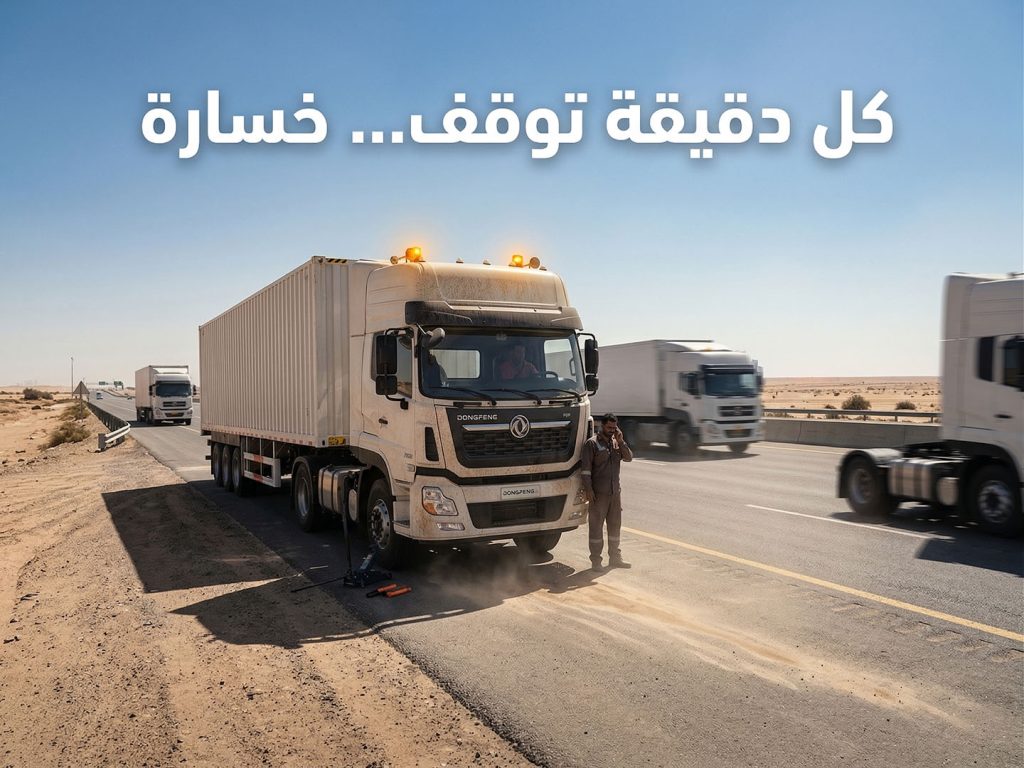
Downtime Doesn’t Cost Just One Day
When purchasing a business truck in Riyadh or anywhere in Saudi Arabia, it’s natural to start with the purchase price:
How much will I pay today? What’s the price difference between options?
However, companies that truly understand profitability ask a different question:
How much will the truck actually work… and how often will it stop?
Because downtime—regardless of the cause—doesn’t just stop the truck.
It disrupts an entire chain of operations.
At Abdulaziz Al-Qashami Trading Company, this concept is clearly emphasized through a focus on integrated transport solutions—combining trucks, spare parts, and after-sales services to ensure reliability.
From a marketing perspective, this transforms the company from a simple “seller” into an operational partner.
The Real Cost of Downtime (A Practical Estimate)
Let’s break it down financially:
Industry estimates suggest that the daily cost of downtime for a fleet vehicle ranges between $448–$760 per day per vehicle.
Converted to Saudi Riyals (at 3.75 SAR/USD), this equals approximately:
SAR 1,680 – SAR 2,850 per day
Now consider this:
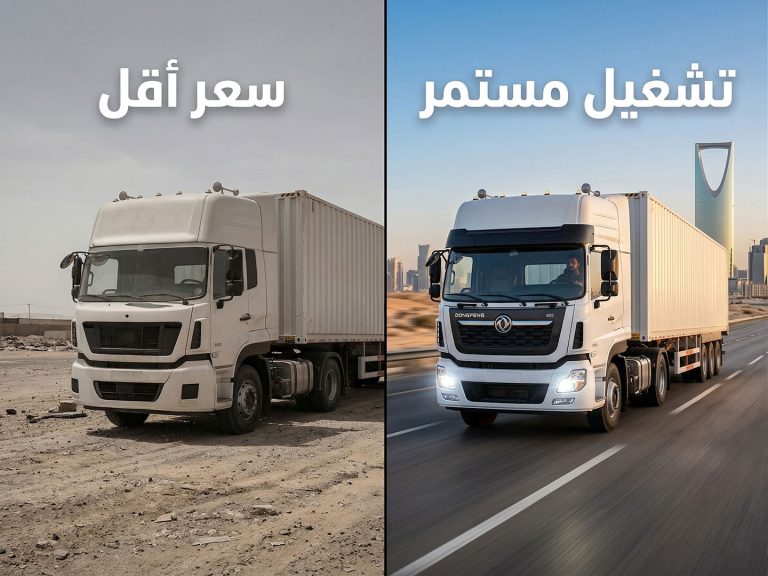
If you save SAR 30,000 when purchasing a cheaper truck,
just 11–18 additional downtime days could completely eliminate that saving—
before even accounting for repair costs, towing, overtime labor, delayed deliveries, or penalties.
Downtime Isn’t Just Mechanical Failure
Downtime doesn’t always come from breakdowns.
According to fleet management insights, it can also result from:
- Compliance violations
- Parts failure
- Weather conditions
- Operational inefficiencies
As highlighted by Platform Science,
a truck that is not moving represents lost productivity, reduced customer satisfaction, and potential damage to company reputation.
In Saudi Arabia, there is an additional factor:
transport regulations may impose penalties such as vehicle suspension or impoundment in case of violations—creating forced downtime with direct financial impact.
The Wrong Question vs The Right Question
If you’re searching for the “best price,” you’re asking a logical question…
but an incomplete one.
The real question in the Saudi truck market is not:
How much will I pay today?
But rather:
How much will the truck work tomorrow, next month, and next year?
Because a truck is not just a product—it is an operating asset expected to generate daily returns.
Operational Continuity: The Real Value Proposition
At Abdulaziz Al-Qashami Trading Company—the authorized distributor of Dongfeng Motor Corporation trucks in Saudi Arabia—
trucks are offered as part of a complete operational solution, including:
- The truck itself
- Genuine spare parts
- After-sales support
This shifts the conversation to what truly matters:
Operational continuity

A Simple Truth
You may save money upfront…
but unplanned downtime can turn that saving into a net loss.
Industry estimates again show:
SAR 1,680 – SAR 2,850 per day of downtime (approximate, varies by operation).
Imagine the price difference between two options is SAR 30,000.
If the cheaper option results in just 11–18 extra downtime days,
your entire saving is gone—before considering:
- Repair costs
- Recovery and towing
- Delivery delays
- Customer dissatisfaction

What You Should Really Ask Before Buying
To protect your business, ask the right questions:
- Are genuine spare parts readily available?
- Where will maintenance be performed? Planned or reactive?
- Who provides technical support when needed?
- Is there an authorized distributor with reliable after-sales service?
How Al-Qashami Supports Operational Continuity
At Abdulaziz Al-Qashami Trading Company, the answers are built around three key pillars:
1. Availability of Genuine Spare Parts
Integrated warehouses across the Kingdom provide a wide range of parts, including:
- Engines
- Electrical systems
- Suspension and braking
- Body components
- Oils and fluids
Fast availability is a core part of the service model.
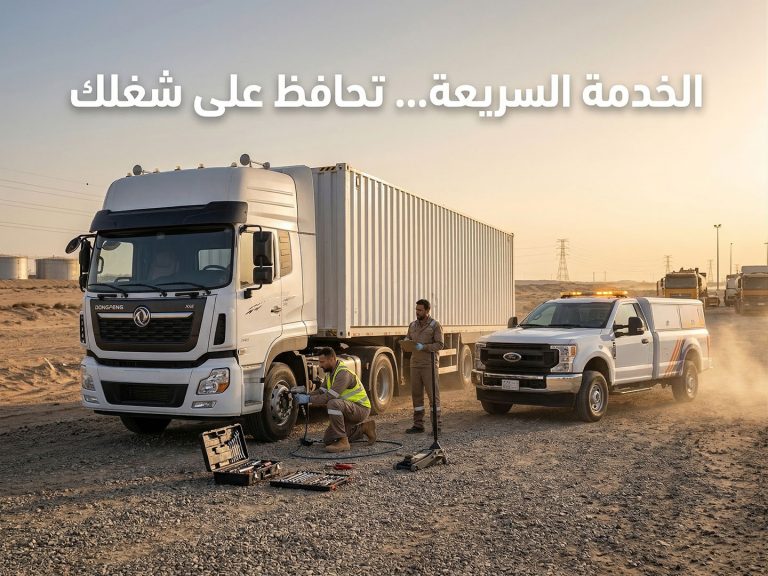
2. Equipped Maintenance Workshops & Roadside Support
- Fully equipped service workshops
- On-road technical support teams
This ensures reduced downtime when unexpected issues occur.
3. A Partnership That Starts After Purchase
The company clearly positions service not as an add-on—but as a core part of customer success, ensuring long-term operational continuity.
Make It Practical: Ask for a Clear Plan
Because this is a long-term decision, request a simple written plan from your dealer, including:
- Preventive maintenance schedule (based on usage and operating hours)
- Spare parts availability policy
- Technical support workflow (report → diagnosis → repair → return to operation)
- Response time and uptime recovery metrics
This is not administrative luxury—
it is the foundation of profitability in transport, contracting, and logistics sectors.